/

/

Subway Bridge Bearing Misalignment

Subway Bridge Bearing Misalignment

Location:

Central Europe

Type of construction:

Subway Bridge

Sensor type:

6D sensor

Subway Bridge

Monitoring the Tilt and Displacement of an Elastomeric Bearing

These companies rely on our sensor technology

Logo: The Highway
DB
OeBB_INFRA logo
PORR Logo
STRABAG Logo
Asfinag_Logo
Intermetric Logo
Axpo logo
GalaxyCity Logo
BHOE Logo
Logo of the Diocese of St. Pölten
GEOSYS International Logo
City of Vienna logo
SalzburgAG logo
Logo-ZP
Logo-RETTER-and-Partners
Logo-Poettinger
Logo-NOE-Railways
Logo-NOE
Logo - HEIGL-BAU
Logo City Vienna
Pictures (10)
Pictures (9)

Background

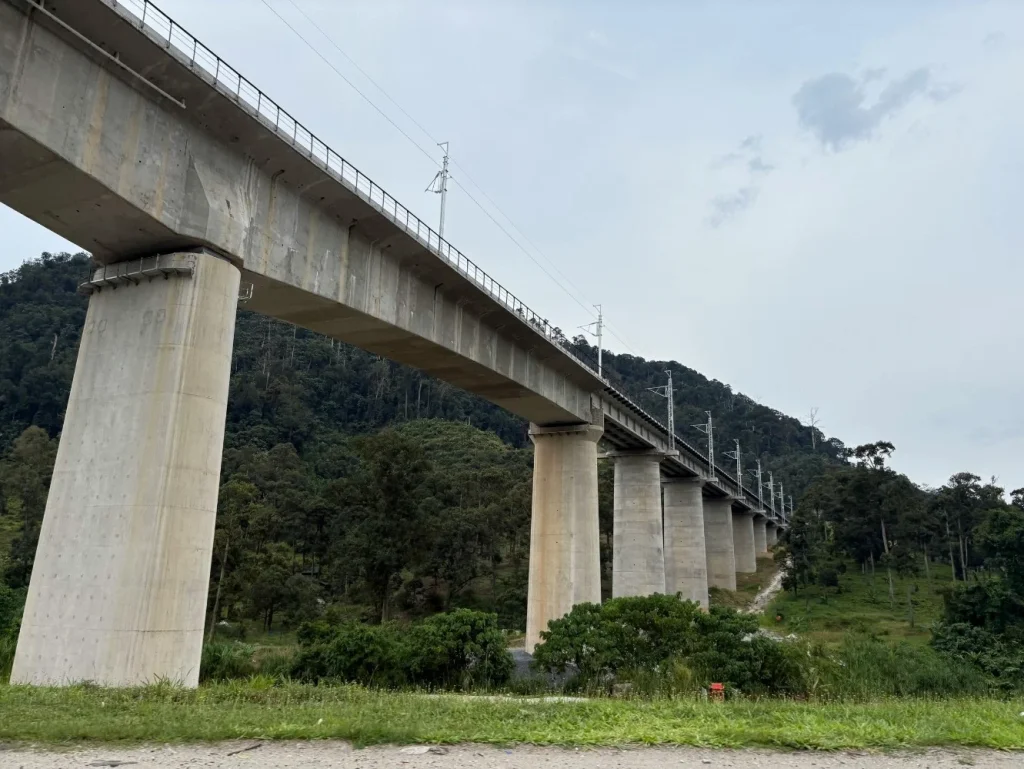
During a routine inspection of a Central European subway bridge, significant misalignment and displacement of an elastomeric bearing were detected. Since it was unclear how the damaged bearing would continue to behave during ongoing operation and whether the deformations would continue to increase, those responsible ordered a metrological investigation.

Requirements

To assess the bridge’s safety, a measurement method was needed to comprehensively document complex movements. The system had to accurately record three-dimensional motion and temperature data over the long term in order to precisely correlate deformation behavior over the course of the seasons and provide a sound basis for decision-making regarding maintenance measures.

Solution

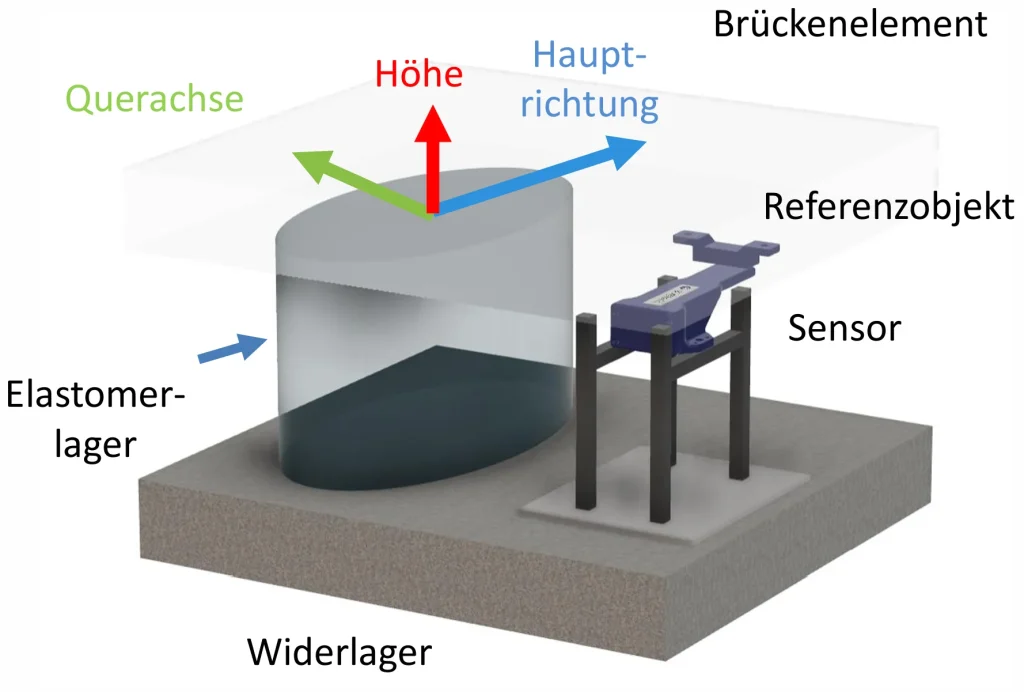
To meet these requirements, the bridge was equipped with state-of-the-art 6D sensors from SuessCo Sensors in the area of the affected bearings. Over a period of one year, the sensor system continuously recorded all changes in movement as well as the corresponding temperature data. This long-term monitoring made it possible to analyze the structure’s mechanical responses to thermal influences throughout the seasons.

The measurements documented movements of up to 2.5 cm along the main axis, as well as displacements of up to 0.9 mm in the transverse axis. It was determined that the misalignment of the bearing remained stable and correlated with temperature, and that after cycling through all seasons at a constant temperature, the component returned exactly to its initial position. Thanks to this precise data set, the operator obtained proof that there was no progressive deterioration. Based on the monitoring data, the relevant measures were identified to maximize the remaining service life of the infrastructure.


Let’s talk about your building

During the consultation, we’ll determine which sensors are right for your project and how quickly they can be installed. No obligation, no preparation required.

A man with his arms crossed and a smile