Downloads
Download User Manual (German)
Detailed instructions on how to use the sensors will help you better understand all the nuances of working with our monitoring systems.
Download Operating Manual (English)
Detailed instructions on how to use sensors will help you better understand all the intricacies of working with our monitoring systems.
Download Installation Template (DE)
A schematic diagram of the sensor showing the specified dimensions on a 1:1 scale, so you can better understand the device's dimensions before installation.
FAQ
Frequently Asked Questions
Do you have any questions? We're happy to help.
General:sensors@suessco.com
Technical Support:support@suessco.com
You can find more detailed FAQs here:
Sensors
What is a 6D sensor?
SuessCo 6D sensors are based on innovative magnetic field technology and enable contactless, precise measurement of the movements and rotations of building components relative to one another.
SuessCo 6D sensors are based on innovative magnetic field technology and enable contactless, precise measurement of the movements and rotations of building components relative to one another.
The SuessCo 6D sensor is easy to install and continuously provides precise data on the condition of the monitored component directly to the SuessCo Dashboard. In addition, the sensor simultaneously monitors component movements in six dimensions: it measures movements along the X, Y, and Z axes, as well as rotations of the component in the Euler angles α, β, and γ.
What is the advantage over conventional crack sensors?
Conventional measurement methods have several problems:
Analog methods such as “crack gauges” or “crack rulers” are simply scales that allow changes to be read. Measurements and documentation must be performed manually by a person on site. This is time-consuming, expensive, and both the frequency of measurements and the accuracy are limited.
The SuessCo 6D sensor consistently provides precise real-time data, permanently records it, and displays it graphically. You receive data as if the crack monitor were being monitored and recorded by a person 24/7. But the entire process is wireless, convenient, and can be maintained over long periods of time.
Mechanical methods such as “vibrating wire sensors” measure only one dimension per sensor. Measuring three dimensions requires complex setups with multiple sensors, which are time-consuming and expensive to install.
What is the difference between the 6D sensor and the 3D sensor?
Both sensors consistently provide high-quality measurement data. The 6D sensor provides data on component displacement and rotation. In addition, the 6D sensor can be expanded with additional external sensors, covering a broader range of applications. The 3D sensor provides data on component displacement; changes in the angles between components (“tilt”) are not recorded.
What is the 6D sensor made of?
The sensor assembly consists of two parts: a sensor unit and a reference magnet. The sensor unit detects the movements of the reference magnet without physical contact. The communication module for transmitting data is already integrated into the sensor housing. A power supply is also required (battery box or external power supply).
What can 6D sensors be used for?
SuessCo 6D sensors enable the monitoring of movements or rotations of components relative to one another. For example, cracks in buildings, the movement of bridge components, and any other movement can be recorded digitally, precisely, and continuously.
What level of measurement accuracy and what measurement range do 6D sensors offer?
The sensor offers high measurement accuracy of ±50 µm for the linear axes (x, y, z) and ±0.2° for the rotational values (α, β, γ). The sensor also features a built-in temperature sensor with an accuracy of ±0.5°C. Measurement accuracy is ensured by magnetic field technology, which exhibits no drift or wear.
What are the dimensions of the 6D sensor?
- 6D sensor: 170 mm × 130 mm × 45 mm
- Reference magnet: 65 mm × 65 mm × 32 mm
What measurement ranges do these sensors cover?
- X-axis: up to 60 mm (extendable longitudinal measuring range)
- Y- and Z-axes: between 20 and 30 mm
- α, β, γ: up to 360°
What temperature range can these sensors handle?
Temperature: between -30 °F and +60 °F
INSTALLATION
How can the sensor be installed?
Installation is simple and can be done in a variety of situations. It can be mounted using screws, threaded rods, magnets, adhesive, or mounting rails. Both the sensor and the magnet have two mounting points, each with a diameter of 8 mm.
In what position can the sensor be mounted?
The sensor can detect the reference magnet both below and above the sensor, offering a wide range of mounting options. The sensor does not require a specific orientation and can be mounted either vertically or horizontally.
How precise does the installation need to be?
SuessCo sensors are easy to install because they have a wide measurement range and self-level. In addition, the zero point of the measurement can be reset in the SuessCo Dashboard after installation. The sensor does not need to be precisely aligned, as it self-levels. Magnetic field technology makes it possible to detect the position and rotation between two objects, even without specific alignment relative to each other.
How can I tell if the installation was successful?
The sensor is activated by a magnet during installation and immediately begins transmitting measurement data. The measurement data can be viewed in the SuessCo Sensors Dashboard.
DASHBOARD
How can I view the readings?
The measured values are transmitted wirelessly from the sensor to the SuessCo Dashboard, where they are displayed graphically over time.
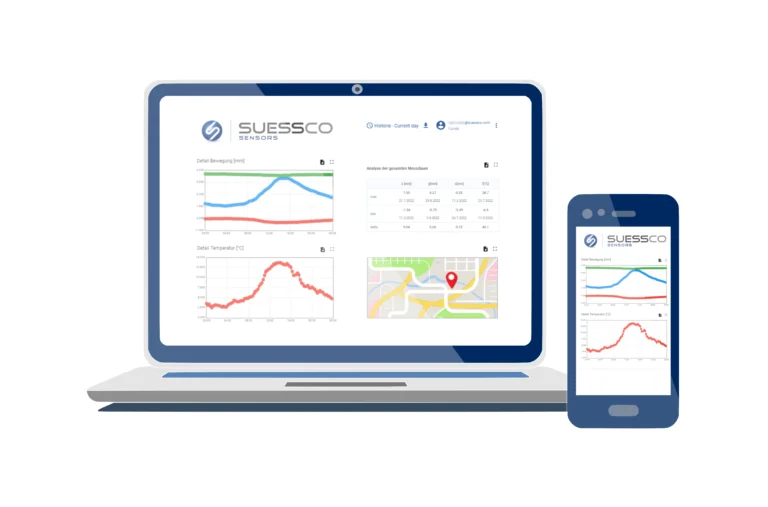
How do I access the dashboard?
We will send you the login credentials as soon as the sensors are on their way to you or have been installed by us.
How often does the sensor take a reading?
The measurement interval can be customized in the dashboard. The minimum measurement interval is two minutes. We recommend a daily measurement as the maximum interval. The data transmission interval to the dashboard can be set to sync with the measurements. However, longer intervals are also possible, which can extend battery life.
Can I export the metrics and display them on my own dashboard?
Yes, that is possible. You can export the measurement data as a file (for example, as a .CSV file) or connect to your system via an API.
Please contact us for more information about API integration - sensors@suessco.com
Can I set thresholds and receive a notification when they change?
Limits and alarm thresholds can be set for all dimensions. The alarm function allows you to receive notifications when measured values exceed or fall below specific thresholds. Thresholds can be set individually, depending on the application and your needs. Notifications are sent via email.
Is the dashboard multi-tenant? Does it have user management?
As a service provider with multiple clients and projects, you can conveniently manage all projects from a single interface. In addition, you can use the permissions and user management features to grant your clients limited access to specific sensors, projects, and data. The multi-tenant architecture ensures that your clients can only view their own data.
Is it possible to display multiple sensors on a dashboard?
Any number of sensors can be grouped together in a dashboard.
Is it possible to integrate sensors from third-party manufacturers?
It is generally possible to integrate additional sensors. The SuessCo Dashboard can receive and display sensor data via APIs. This makes it possible to visualize complex projects involving multiple sensor dimensions within a single interface.
If you have any further questions, we are of course always happy to help
Phone number
Location
SuessCo Sensors FlexCo
Wiener Straße 6,
3130 Herzogenburg,
Austria
Let’s talk about your building
During the consultation, we’ll determine which sensors are right for your project and how quickly they can be installed. No obligation, no preparation required.