Cracks, structural movements, and deformations often develop over extended periods of time. Regular structural inspections provide a snapshot of the structure’s condition at specified inspection times. Sensor-based bridge monitoring supplements these inspections with continuous or frequent measurement data, revealing changes that occur between inspection intervals.
The best sensor for the job depends on the specific monitoring task. This article explains which sensor types measure which parameters and what you should consider when making your selection.
Which sensor measures what?
The selection of sensors does not begin with the product, but rather with the question of what changes to the structure need to be detected and evaluated.
| Monitoring task | Appropriate Sensors |
|---|---|
| Local Strains and Changes in Stress | Strain gauges or fiber Bragg gratings |
| Vibrations and Dynamic Load-Bearing Behavior | Acceleration Sensors |
| Changes in Slope | Tilt Sensors |
| One-Dimensional Translations | Displacement Transducer |
| Crack opening in one direction of measurement | Crack sensors or displacement transducers |
| Spatial Fault or Tectonic Movements | Multidimensional Position Sensors |
| Distributed strain across larger sections of a component | Distributed Fiber-Optic Sensing |
Depending on the monitoring task, multiple sensor types can be combined. It is crucial that the measured variable, measurement range, and measurement interval are tailored to the structure and the specific problem at hand.
Which sensors are suitable for crack monitoring?
Cracks in bridges can be caused by, among other things, settlement, material fatigue, temperature changes, or localized stress concentrations.
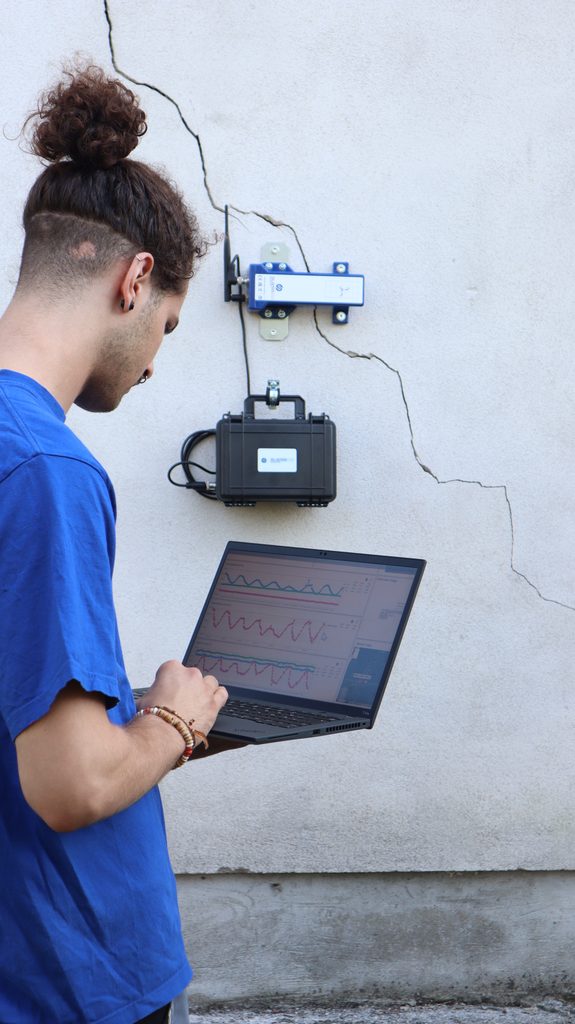
For classic one-dimensional crack width measurement, displacement transducers or special crack sensors can be used. They are mounted above the crack and measure the relative movement between the two sides of the crack in a defined direction.
If lateral displacements or rotations are also relevant in addition to the crack opening, a one-dimensional measurement is not always sufficient. In this case, multidimensional position sensors provide additional information about the spatial motion behavior.
When monitoring cracks with the SuessCo 6D sensor, the relative movements between the sensor and the reference object are recorded in six degrees of freedom. This makes it possible to document not only the crack opening but also lateral displacements and rotations of the crack edges.
How are bridge bearings monitored?
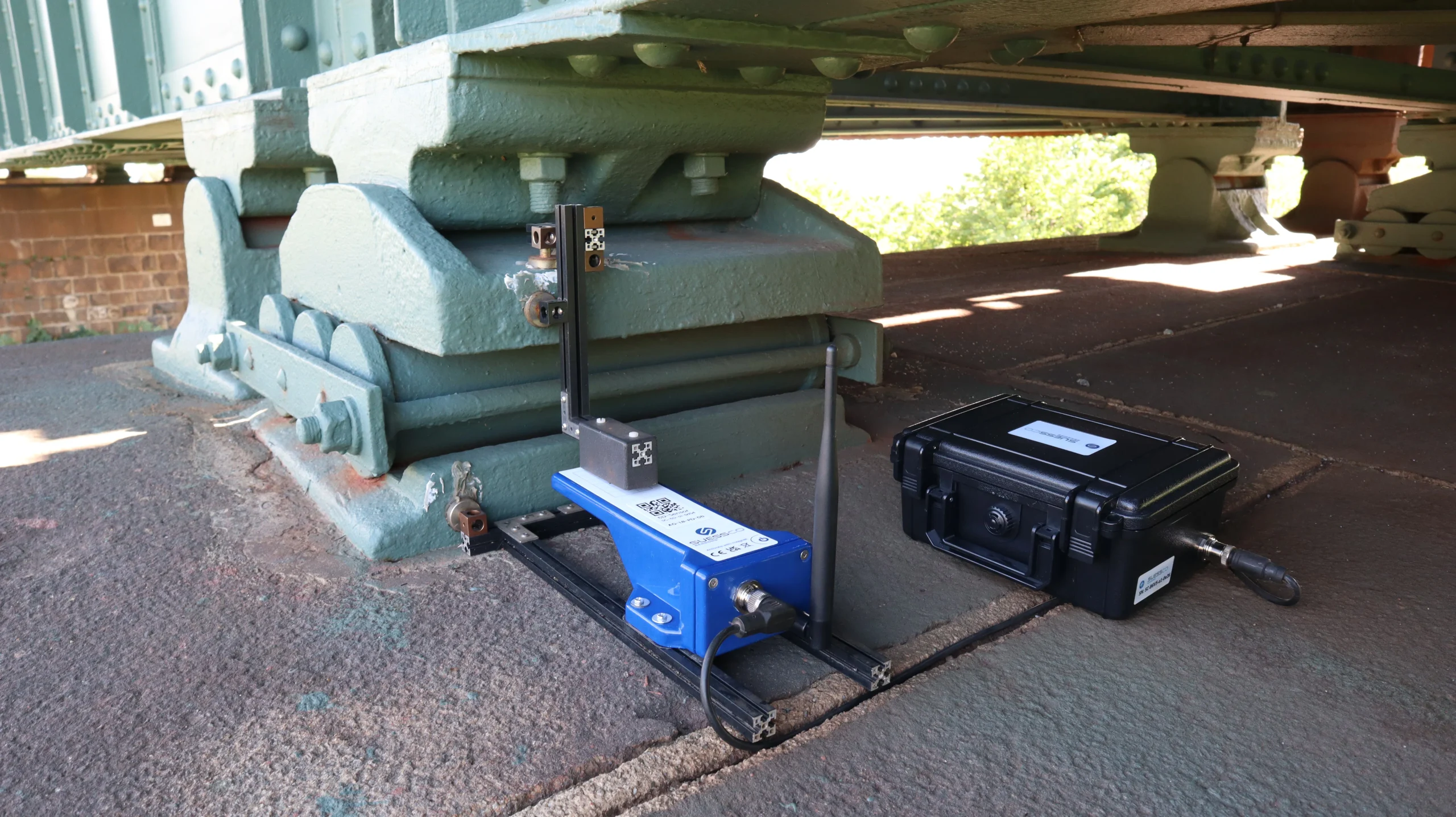
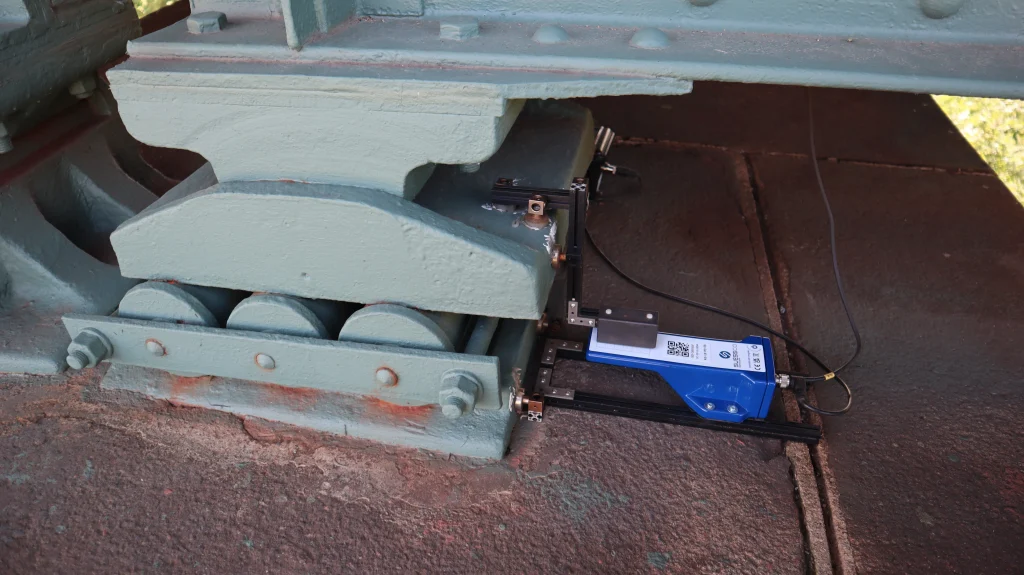
Bridge bearings transfer forces from the superstructure to the substructure and allow for normal movements, such as those caused by temperature changes or traffic loads.
Displacement transducers, tilt sensors, or multidimensional position sensors can be used to monitor them. Displacement transducers measure linear displacements, while tilt sensors detect changes in rotation. Multidimensional sensors, such as the SuessCo 6D sensor, can measure both types of motion in a single measurement setup.
It is crucial to compare the measurement data with the expected temperature- and load-dependent behavior. Deviations may indicate, for example, misalignment, a blockage, or settlement.
At the Danube Bridge between Krems and Mautern, 6D sensors were used to continuously monitor movements at the bridge bearings and abutments during ongoing renovation work.
What role do data transmission and alerting play?
A monitoring system consists of more than just sensors. Power supply, data transmission, storage, and analysis also affect its long-term functionality.
Wireless transmission via cellular networks or Wi-Fi can reduce the amount of wiring required on a building. However, during the planning phase, radio coverage, measurement intervals, energy requirements, and accessibility for maintenance must be taken into account.
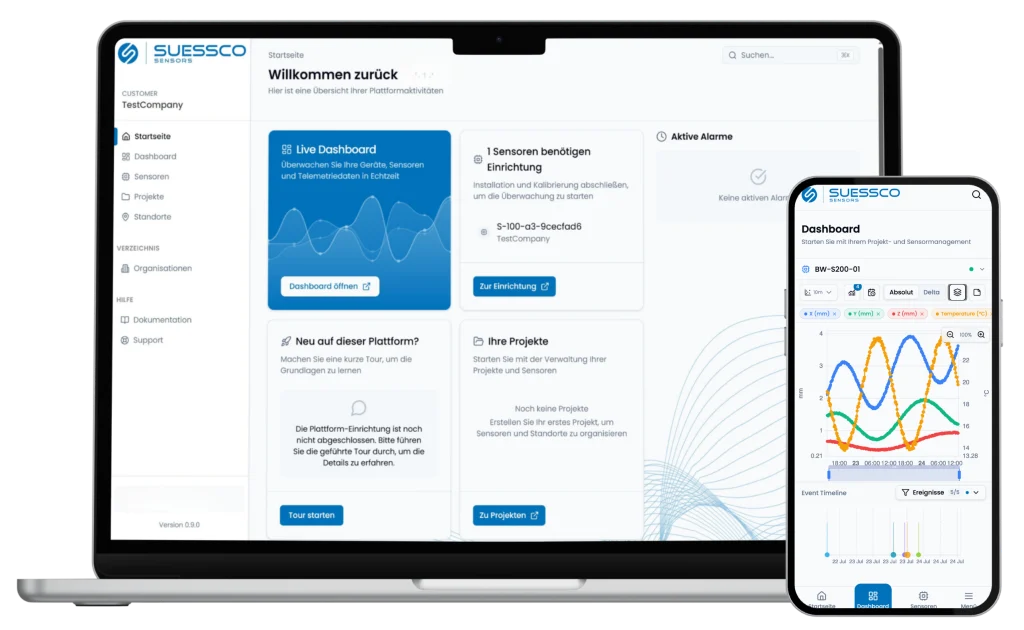
The SuessCo 6D sensor transmits its measurement data to the SuessCo Datahub via LTE-M or Wi-Fi. There, the measurement values can be displayed as time series, exported as CSV files, and integrated into other systems via an API.
Project-specific threshold values can be defined for each measurement point. If a threshold is exceeded, the system automatically sends a notification. However, exceeding a threshold does not automatically indicate a safety-critical change. For a technical assessment, temperature, operating conditions, and the measurement trend over time must also be taken into account.
What should you look for when selecting a sensor?
The selection process begins with the question of which change needs to be identified and which decision should be supported by the measurement data. The most important criteria include:
- Measured variable and measurement range
- required repeatability
- Measurement interval or sampling rate
- Environmental conditions at the measurement point
- Power Supply and Data Transmission
- Installation and Maintenance Effort
Equally important are the positioning and orientation of the measurement points. The measurement concept, installation location, and threshold values should therefore be determined on a project-by-project basis.
Conclusion: The measurement task determines the sensor
There is no single "best" sensor for bridge monitoring. Displacement transducers are suitable for linear displacements, accelerometers for vibrations, and strain gauges for local stresses.
If both displacement and rotation need to be measured simultaneously, multidimensional position sensors can capture multiple motion variables in a single measurement setup. This is particularly relevant for monitoring cracks and bridge bearings.
Which sensor system is right for your bridge?
Would you like to determine which measurement parameters are relevant for your bridge? We’ll work with you to define the monitoring task, identify suitable measurement points, and select the appropriate sensors.
Upon request, we can also show you how measurement values, time series, and alerts are displayed in the SuessCo Datahub.
FAQs About Bridge Monitoring Sensors
Which sensor is best suited for bridge monitoring?
That depends on the measurement task. Displacement transducers measure linear displacements, acceleration sensors detect vibrations, and strain gauges measure local strains. If both displacements and rotations need to be monitored simultaneously, multidimensional position sensors are the appropriate choice.
What does a bridge monitoring sensor measure?
A bridge monitoring sensor measures physical parameters such as strain, acceleration, tilt, displacement, or crack width. The measured values indicate structural changes in the bridge and serve as the basis for maintenance decisions.
How do sensors monitor cracks in bridges?
Sensors are mounted on both sides of a crack and measure the change in crack width as a differential value. With its 6D sensor, SuessCo Sensors also measures lateral displacements and tilts of the crack flanks in six degrees of freedom.
What are the benefits of wireless bridge monitoring?
Wireless transmission via LTE-M or Wi-Fi eliminates the need for complex cable runs on the structure. SuessCo sensors transmit measurement data directly to the SuessCo Datahub, allowing you to access real-time trends and threshold alarms right from your desk.
How long do the batteries in bridge sensors last?
Battery life depends on the measurement interval and the transmission protocol. Sensors from SuessCo Sensors have a battery life of up to 10 years. No battery replacement is necessary within the typical maintenance intervals for your structure.
When is a multidimensional sensor useful?
A multidimensional sensor is a worthwhile investment if you need to measure both motion and rotation at the same measurement point. The SuessCo 6D sensor measures all six degrees of freedom with a single setup, thereby simplifying installation and data analysis.